Why do consumers pick certain products? When do they decide to buy those specific products? When is their purchase decision influenced?
These are all extremely important decisions for your marketing strategy. The recession seems to have scrambled the purchase decision criteria for a lot of consumers. The only way to know is to watch and ask. Research will give you the insights that will guide your strategy. There is a good article in Ad Age this week by Rick Roth.
Boost Your Brand by Understanding the Path to Purchase - Advertising Age - CMO Strategy
There was also an article in Ad Age about P&G shifting their focus and resources to in store promotion. My guess is that they have done the research and understand that in this new economic environment more and more purchase decisions are being made in store based on price and placement.
Saturday, September 26, 2009


Thursday, September 24, 2009
Behind the Rebranding Campaign of Wal-Mart’s Scarlet Woman | Fast Company
This was a useless article, but much like a car crash. You can't look away. It is a sad, twisted tale. I am still trying to sort out the meaning of this story.
Behind the Rebranding Campaign of Wal-Mart’s Scarlet Woman | Fast Company
Perhaps sometimes people and companies get what they deserve.
Perhaps sometimes we need to understand that newspaper and magazine articles only tell one dimension of a story.
Perhaps Julie had the wrong values.
Perhaps Wal Mart couldn't handle an edgy woman.
And perhaps Julie shouldn't have agreed to do this article...I am not judging her behavior or performance at Wal Mart. I am just saying that if I were advising her on her PR and career, I would have counseled against doing this.
But the sun is a strong lure for Icarus.
Posted using ShareThis
Behind the Rebranding Campaign of Wal-Mart’s Scarlet Woman | Fast Company
Perhaps sometimes people and companies get what they deserve.
Perhaps sometimes we need to understand that newspaper and magazine articles only tell one dimension of a story.
Perhaps Julie had the wrong values.
Perhaps Wal Mart couldn't handle an edgy woman.
And perhaps Julie shouldn't have agreed to do this article...I am not judging her behavior or performance at Wal Mart. I am just saying that if I were advising her on her PR and career, I would have counseled against doing this.
But the sun is a strong lure for Icarus.
Posted using ShareThis
Avoid Sucky Presentations
How many bad presentations have you sat through? Or worse, how many bad presentations have you given?
Its not easy to put together a good presentation. What's the formula? It seems a bit like Judge Potter's definition of pornography: "I can't tell you what it is, but I know it when I see it."
So I offer three tools to help.
A How To Guide for Building A Great Presentation
The first is Extreme Presentation Method a methodology by Dr. Andrew Alba at Catholic University.
"The Extreme Presentation method is a step-by-step approach for designing presentations of complex or controversial information in ways that drive people to action. It is based on extensive empirical research and has been pilot tested among leading corporations, including Microsoft, Exxon-Mobil, Kimberly-Clark, eBay, and Motorola."
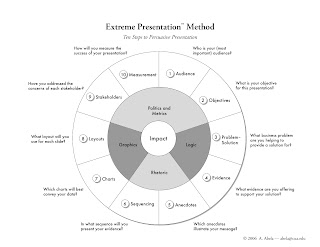 This site is a great resource. It will walk you through all the major elements you need to consider when putting together a presentation. And the advice is really good. Look at his explanation of Ballroom Presentations for Conference Room Presentations:
Pictures Tell A Thousand Words
Eliminate the 11 point font pages with paragraphs of text. There is a better way. The other presentation to look at is by Seth Godin, marketing guru. If you don't know Seth Godin you have to check out his blog.
Seth has a book out called Tribes which is a good quick read. He posted a presentation that he did about the book to slideshare and I have posted it below. This is one way of doing a presentation. It uses images to tell the story. Remember? A picture tells a thousand words? Well, I assure you that if you can do even a little of this in your presentation, people will remember it.
Seth Godin on TribesView more presentations from sethgodin.
Borrow and Steal
And lastly, I recommend the site Slideshare. There are thousands of presentations posted by users all over the world. What better way to develop a good presentation than to look at a few dozen to see what works for you, what catches your eye, what doesn't work. You will pick up at least five good ideas by spending 15 minutes on this site.
Its not easy to put together a good presentation. What's the formula? It seems a bit like Judge Potter's definition of pornography: "I can't tell you what it is, but I know it when I see it."
So I offer three tools to help.
A How To Guide for Building A Great Presentation
The first is Extreme Presentation Method a methodology by Dr. Andrew Alba at Catholic University.
"The Extreme Presentation method is a step-by-step approach for designing presentations of complex or controversial information in ways that drive people to action. It is based on extensive empirical research and has been pilot tested among leading corporations, including Microsoft, Exxon-Mobil, Kimberly-Clark, eBay, and Motorola."
 This site is a great resource. It will walk you through all the major elements you need to consider when putting together a presentation. And the advice is really good. Look at his explanation of Ballroom Presentations for Conference Room Presentations:
A presentation idiom is a form of expression with an associated set of design principles. I call the two main types of presentation idiom Ballroom style and Conference Room style. Ballroom style presentations are what most typical PowerPoint presentations are trying to be: colorful, vibrant, attention-grabbing, and (sometimes) noisy. They typically take place in a large, dark room—such as a hotel ballroom. Conference room style presentations are more understated: they have less color, with more details on each page; they are more likely to be on printed handouts than projected slides, and they are more suited to your average corporate conference room.
The biggest single mistake that presenters make—and the root cause of the PowerPoint debate—is confusing the two idioms, and particularly, using ballroom style where conference room style is more appropriate. Almost all PowerPoint presentations are given using ballroom style—yet most of the time presentation conditions call for conference room style. Ballroom style is appropriate for where the objective is to inform, impress, and/or entertain a large audience and where the information flow is largely expected to be one-way (presenter to audience). Conference room style presentations are more suited to meetings where the objective is to engage, persuade, come to some conclusion, and drive action. This covers any presentation where you want your audience to do something differently as a result of your presentation. It includes: making recommendations; selling; training; communicating the implications of research; and raising funds. Information flow in this idiom is expected to be two-way—it’s more interactive.
Pictures Tell A Thousand Words
Eliminate the 11 point font pages with paragraphs of text. There is a better way. The other presentation to look at is by Seth Godin, marketing guru. If you don't know Seth Godin you have to check out his blog.
Seth has a book out called Tribes which is a good quick read. He posted a presentation that he did about the book to slideshare and I have posted it below. This is one way of doing a presentation. It uses images to tell the story. Remember? A picture tells a thousand words? Well, I assure you that if you can do even a little of this in your presentation, people will remember it.
Seth Godin on TribesView more presentations from sethgodin.
Borrow and Steal
And lastly, I recommend the site Slideshare. There are thousands of presentations posted by users all over the world. What better way to develop a good presentation than to look at a few dozen to see what works for you, what catches your eye, what doesn't work. You will pick up at least five good ideas by spending 15 minutes on this site.
Tuesday, September 22, 2009
Brilliant Move By Census Bureau and Telemundo
Marketers pay attention. A brilliant effort by the Census Bureau, yes the U.S. government, and Telemundo may have a big impact on the quality of Census data and the cost to advertise on Spanish language stations.
Census Bureau Uses Telenovela to Reach Hispanics - NYTimes.com


Tele-novelas, the Spanish language version of soap operas, are a tried and true format. Increasingly, the format is being used to send social messages. Recent examples include drunk driving and home ownership. The latest is an effort by Telemundo and the Census to tell Latinos that they should not be scared to give their information to the Census takers. With all the news of deportations in the last 4 or 5 years, their hesitation is understandable.
But the impact of not counting everyone is great. And yes, illegal immigrants do get counted in the Census. Telemundo is certainly acting in some self interest. The more Latinos the more they can charge for advertising. So it makes sense then, that they are covering the cost of production and airing of the program.
It will be interesting to see what kind of impact an effort like this has. Telemundo remains the smaller network. Univision has about twice as many viewers on most nights. Regardless, this is an innovative approach to solving the consistent problem of under counting Latinos in the decennial census.
Census Bureau Uses Telenovela to Reach Hispanics - NYTimes.com

Tele-novelas, the Spanish language version of soap operas, are a tried and true format. Increasingly, the format is being used to send social messages. Recent examples include drunk driving and home ownership. The latest is an effort by Telemundo and the Census to tell Latinos that they should not be scared to give their information to the Census takers. With all the news of deportations in the last 4 or 5 years, their hesitation is understandable.
But the impact of not counting everyone is great. And yes, illegal immigrants do get counted in the Census. Telemundo is certainly acting in some self interest. The more Latinos the more they can charge for advertising. So it makes sense then, that they are covering the cost of production and airing of the program.
It will be interesting to see what kind of impact an effort like this has. Telemundo remains the smaller network. Univision has about twice as many viewers on most nights. Regardless, this is an innovative approach to solving the consistent problem of under counting Latinos in the decennial census.
Tuesday, September 15, 2009
University of Phoenix Spends $100 Million Annually on Advertising - Advertising Age - News
Traditional universities hate to think of themselves as brands. I guess it cheapens their work as educators. But let's be real. Colleges and universities have brands that must be understood, shaped, nutured, and managed....managed just like a company would manage a brand.
There have been some really interesting articles recently about the future of traditional higher education, especially given the economic crisis and the ridiculously high price of most 4 year universities. Some see this as a classic paradigm shift = business opportunity. Try this article in Fast Company: Who Needs Harvard?
The for profit higher ed market has been growing exponentially over the last 10-20 years. The Internet has only accelerated the growth.
Interestingly, these schools are as much marketing machines as institutions of learning. None is as clear as University of Phoenix. It spends $100 Million a year on advertising, but as the artcle in AdAge offers, they may not be much better at defining their brand than traditional schools.
University of Phoenix Spends $100 Million Annually on Advertising - Advertising Age - News
The for profit schools have two key problems: 1) attracting paying students and 2) establishing their credibility and quality. And success establishing credibility will help in attracting students.
But interestingly, I don't see any of these schools address this issue. Most of the advertising I see or here is targeted to their current demographic of non traditional, older students and focuses on convenience and the non traditional nature of their student body as a way to attract non traditional, older students.
Why not spend some of that $100 million to establish credibility? Until most people think online learning and for profit schools are in the same category of quality as traditional higher education, the value of their degrees will be diminished. If I were marketing one of these schools, I would create a consortium of my competitors to throw in marketing dollars and launch a campaign to build credibility. It will take years, but it is the best long term hope for the business.
There have been some really interesting articles recently about the future of traditional higher education, especially given the economic crisis and the ridiculously high price of most 4 year universities. Some see this as a classic paradigm shift = business opportunity. Try this article in Fast Company: Who Needs Harvard?
The for profit higher ed market has been growing exponentially over the last 10-20 years. The Internet has only accelerated the growth.
Interestingly, these schools are as much marketing machines as institutions of learning. None is as clear as University of Phoenix. It spends $100 Million a year on advertising, but as the artcle in AdAge offers, they may not be much better at defining their brand than traditional schools.
University of Phoenix Spends $100 Million Annually on Advertising - Advertising Age - News
The for profit schools have two key problems: 1) attracting paying students and 2) establishing their credibility and quality. And success establishing credibility will help in attracting students.
But interestingly, I don't see any of these schools address this issue. Most of the advertising I see or here is targeted to their current demographic of non traditional, older students and focuses on convenience and the non traditional nature of their student body as a way to attract non traditional, older students.
Why not spend some of that $100 million to establish credibility? Until most people think online learning and for profit schools are in the same category of quality as traditional higher education, the value of their degrees will be diminished. If I were marketing one of these schools, I would create a consortium of my competitors to throw in marketing dollars and launch a campaign to build credibility. It will take years, but it is the best long term hope for the business.
Wednesday, September 2, 2009
Will Advertising Agencies Go the Way of the Newspaper Industry?
The newspaper industry is trapped in a collapsing business model. This is well documented. Technology has forced an evolution of a once solid business model that lastest a couple hundred years. Media companies are all seeking new and sustainable business model and in an increasingly fragmented and specialized marketplace where barriers to entry have been virtually eliminated.
Used to be only those with a printing press could publish. That was a pretty high barrier to entry. In fact, the web has allowed anyone with access to the Internet to be a "journalist." Many will argue about the quality of information being purpogating across the internet by professional and amateur writers. But technology has democratized publishing.
In the analog age, there were real barriers to gathering and reporting news: staff, print or broadcast capabilities, foreign bureaus, telecommunications costs, etc.

So what about Advertising Agencies? Why do we need them? And has the ditigal world changed the business model?
Used to be only those with a printing press could publish. That was a pretty high barrier to entry. In fact, the web has allowed anyone with access to the Internet to be a "journalist." Many will argue about the quality of information being purpogating across the internet by professional and amateur writers. But technology has democratized publishing.
In the analog age, there were real barriers to gathering and reporting news: staff, print or broadcast capabilities, foreign bureaus, telecommunications costs, etc.
So what about Advertising Agencies? Why do we need them? And has the ditigal world changed the business model?
Agencies have always been a place to find bright, creative and strategic thinkers. You go to the full service agency to help develop you marketing strategy -- everything from value proposition to advertising campaign to media buys. And it used to be that the national firms were located in NY and each major city would have a few good firms. This is where talented people would go to find work.
Watch the revenues of the major ad conglomorates over the next few years. I predict continued downward revenue lines. Lets see how they adapt.
But technology is blowing the model apart. Now, it doesn't matter where the client or the talened ad execs are located. You can see and talk to the client daily on your computer. You can create a virtual creative team.
And when a 22 year old can edit video on his MacBook Pro in his mother's basement, it is hard to understand why you need all the infrastructure and overhead of a large firm.
Watch the revenues of the major ad conglomorates over the next few years. I predict continued downward revenue lines. Lets see how they adapt.
Sunday, August 30, 2009
Florida Is Shrinking!
The New York Times has a story yesterday about a recent report from the University of Florida's Bureau of Economics and Business Research which found that Florida's population has shrunk for the first time since perhaps 1900 (with the exception of WWI and WWII) -- "After Century of Growth, Tide Turns in Florida"

The state is very interesting demographically. From a marketers perspective there are many different markets in Florida. It has one of the highest Hispanic populations in the country. The population until recent years skewed much older. South Florida is vastly different than the rest of the state - younger, more Latino. Northern Florida is as deep south as any place in the country. Like many states, Florida is not one market.
So who left? Who is coming? For marketers, the devil is in these details. My guess is that fewer laborers came to the state and a whole bunch of construction workers left. Anyone who has been to Florida in the last 5-10 years has seen the explosion in building. The collapse of the real estate market in Florida over the last 18 months is well documented.
The 2010 Census will be a treasure trove for marketers seeking to understand consumer markets and migration flows. The Pew Hispanic Center also has very good analytical work regarding the Hispanic population in the U.S.
Looks like Florida's loss is Alabama's gain. The 2010 Census should show for sure, but look for the faster growing states in the Southeast and Southwest to continue to grow.
Subscribe to:
Posts (Atom)


